A beachside wind farm surrounded by Datacom brand patterns

Our sustainability journey

Solving problems is what we do at Datacom. We approach our sustainability journey the same way: by working collaboratively with our customers and partners, and pushing ourselves to think in new ways.

Manaaki whenua, manaaki tangata, haere whakamua

Care for the land, care for the people, go forward

Our vision is to make a difference in people’s lives and to enable our customers to thrive and shape their own futures. We understand that a commitment to sustainability is a critical foundation in achieving these outcomes and ensuring we are making a positive contribution to the communities and countries where we live and work.

Datacom is committed to becoming carbon neutral for Scope 1 and Scope 2 emissions by 2030.

Our commitment to renewable energy

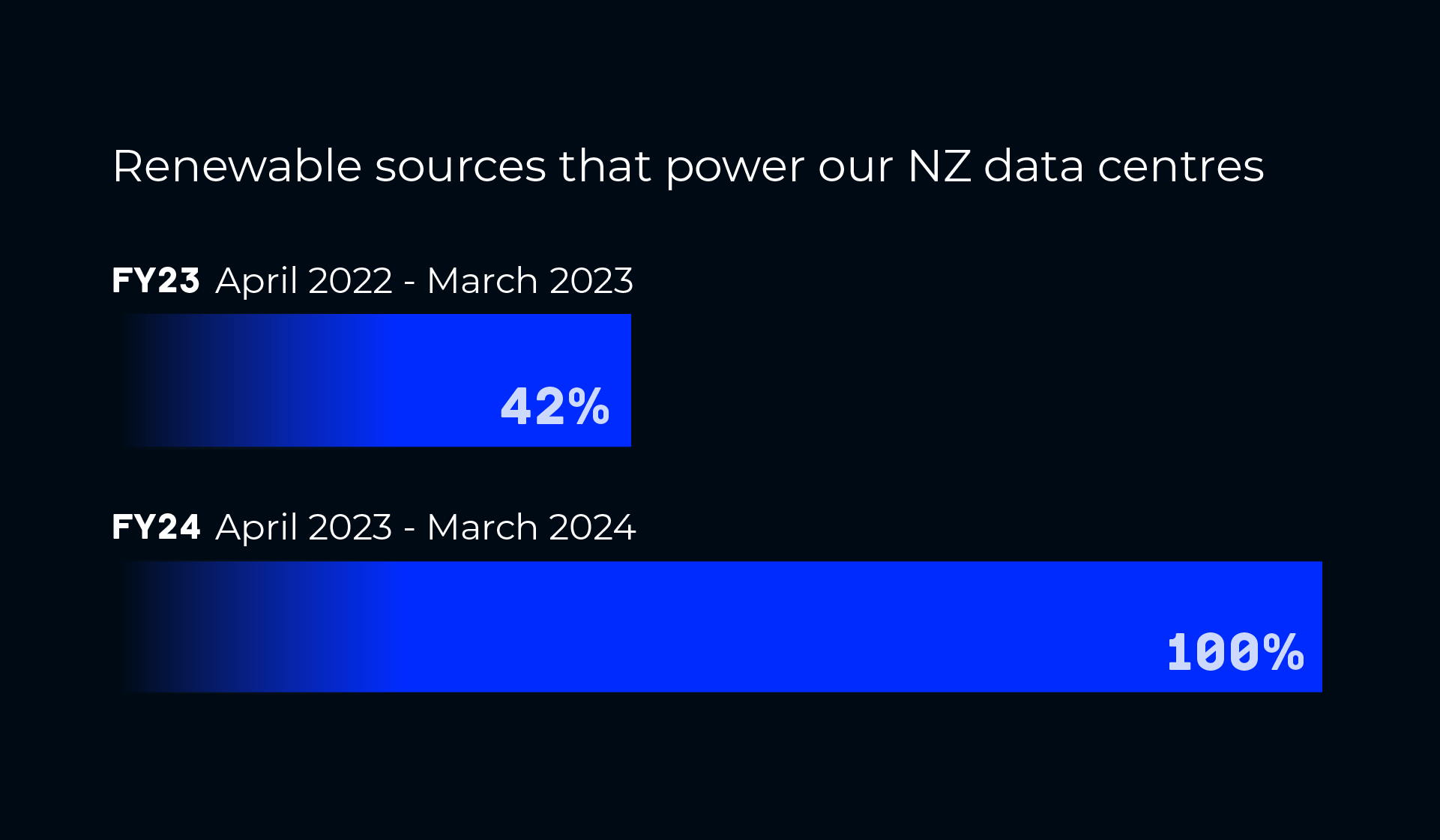
FY2024 was our first full year of renewable energy certificates, this consists of an 100% renewable energy allocation from Mercury Energy for our New Zealand data centres.

Renewable energy Infographic

The steps Datacom is taking to achieve our climate goal by the end of 2030

Our focus is on reducing the emissions from our operations as far as practicable, while strengthening how we measure and understand Scope 3 emissions across our wider value chain.

  • Carbon audits

    We complete annual audits with independent sustainability assurance providers to assure our carbon emissions inventory and carbon accounting is in accordance with ISO –14064-1-2018 and the GHG protocol.
  • Offices

    With a team of over 6,500 people across 26 locations, we have invested in new offices and refurbishments for greater energy efficiency and a reduced property footprint.
  • Data centres

    Our New Zealand data centres are allocated 100% renewable energy., and we are continuously looking for ways to design and operate energy efficient infrastructure to deliver reduced carbon emissions.
  • Waste

    We are investigating an Environmental Management System that captures waste management data from our facilities. We also help our customers meet their sustainability goals by securely repurposing, donating, or disposing e-waste with the Datacom Asset Recovery Services (DARS).
  • Business travel

    We have implemented a travel policy to reduce annual air travel from our FY2020 base year travel figures. We are capturing appropriate flight and travel data from our corporate travel agent and ride-share providers that informs our carbon inventory.
  • Fleet of hybrid electric vehicles

    We are replacing our fleet of business vehicles with hybrid electric vehicles (PHEVs) resulting in a significant reduction in carbon emissions.

How is Datacom supporting the sustainability journey of its customers?

Fish Mainland

Fish Mainland devised a plan to make it easier for recreational fishers to look after their South Island fisheries and then turned to Datacom to help bring that plan to life.

With growing pressure on fish stocks around the country, tensions often emerge between commercial and recreational fishers around the impact of both on marine species and the appropriate levels of allowable catch.

Fish Mainland chairman, Larnce Wichman ONZM, who developed the first voluntary logbook programme for the rock lobster fishery, which has since been digitised and expanded with great success, knows the value of cold, hard data when it comes to fisheries management.

That’s why he and Fish Mainland’s directors, along with their Chief Executive Officer, Randall Bess, have devoted countless hours to planning and creating Mainland Catch, a smartphone app that makes it easy for Fish Mainland’s members and non-members alike to accurately report their fishing catch.

Fisherman casting off beach in Kaikōura Canterbury New Zealand in late afternoon, coast stretching down view of beach, rod held upright

Cawthron Institute

The Azure based platform is allowing researchers at Cawthron Institute to gather, access, and analyse data with unprecedented ease as they nurture Aotearoa’s aquaculture industry.

Cawthron’s research and development supports the success of the local ocean economy, optimising performance and quality of key aquaculture species through sustainable practice.

With the new platform, scientists have a direct feed from sensors and other producers of data to update their research in real time, received by the Azure IoT Hub and fed straight into Azure Data Lake, from where it can be configured into any format required.

“It’s really allowed us to lift our game,” says senior researcher Nick King, who affirms that the project is helping to realise Cawthron’s purpose and deepen their impact as they have gained the capacity to channel their resources into more research and development - ‘where the value really is.’

Research diver interacting with fish under water

Our sustainability commitment

Datacom is helping build a more sustainable future for our customers, communities and the countries we operate in. Sustainability is embedded in how we deliver technology, run our operations and support our customers to achieve their own environmental goals.

We have committed to achieving carbon neutrality across our Scope 1 and Scope 2 emissions by 2030. This means focusing on reducing emissions across our facilities, offices and data centres, supported by strong governance, transparency and accountability. Any residual emissions will be offset through independently verified, high-quality carbon credits in line with recognised international standards.

We are also strengthening our understanding of emissions across our wider value chain by improving data quality, engaging suppliers and identifying further opportunities to reduce environmental impact.

Beyond our own operations, we help customers use technology to improve efficiency, reduce environmental impact and make more informed decisions. Our New Zealand data centres are backed by 100% renewable electricity.

A person sitting in front of a skyline at dusk  looking down at a laptop

Frequently asked questions

What is Datacom’s sustainability goal?

Datacom is working towards becoming carbon neutral for Scope 1 and Scope 2 emissions by 2030. Our focus is on reducing the operational emissions we can directly influence, while continuing to strengthen how we measure and understand Scope 3 emissions across our wider value chain.

How is Datacom reducing its carbon emissions?

We’re taking action across our operations, including improving the energy efficiency of our offices and data centres, reducing business travel and transitioning our business vehicle fleet to hybrid electric vehicles. We also complete annual independent audits of our carbon emissions inventory and accounting.

What is Datacom's approach to renewable energy in its data centres?

Datacom’s New Zealand data centres have a 100% renewable energy allocation. Supported through verified renewable energy certificates, our electricity consumption is matched with renewable generation. Alongside this, we continue to look for ways to design and operate more energy-efficient infrastructure, closely monitoring our Power Usage Effectiveness (PUE).

How does Datacom measure and report its carbon emissions?

Datacom tracks its operational emissions through carbon accounting and completes annual audits with independent sustainability assurance providers. Our carbon emissions inventory and accounting are assessed in accordance with international standards ISO 14064-1:2018 and the Green House Gas Protocol, helping us measure progress and report transparently.

How does Datacom help customers meet their sustainability goals?

We work with customers to explore how technology can support their sustainability ambitions. This includes solutions that help organisations use data more effectively, improve operational efficiency and manage technology assets responsibly. Across our technology lifecycle services, we help customers make more sustainable choices at each stage, from discovery and procurement through to fleet optimisation, extending asset life and responsible end-of-life, supported by carbon reporting and insights.

Why has Datacom updated its climate target?

As part of the continued evolution of our climate strategy, we’ve updated our 2030 climate target to better reflect our commitment to continuously improve how we measure, manage and reduce our emissions.  As a result, we have updated our previous net zero ambition to a target of carbon neutral for Scope 1 and 2 by 2030. 

This refinement recognises that operational emissions (Scope 1 and Scope 2) and value chain emissions (Scope 3) have different drivers, measurement approaches and reduction pathways.  

This separation allows us to take a more tailored approach to managing different emission categories as we continue to improve data quality, engage with suppliers, identify reduction opportunities and dedicate greater focus to understanding and addressing emissions across our value chain. 

Are Scope 3 emissions still a focus?

Yes. While our 2030 target is focused on Scope 1 and Scope 2 emissions, we remain committed to improving our understanding and management of emissions across our value chain. We will continue to improve emissions data, engage with suppliers, and identify opportunities to reduce emissions beyond our direct operations. This work remains an important part of our broader climate strategy and ongoing emissions reduction efforts.

How will Datacom achieve its 2030 target?

Our approach prioritises emissions reductions first. We will continue to reduce emissions across our operations wherever possible, with any residual emissions neutralised through independently verified, high-quality carbon credits in line with ISO 14064-1 and the GHG Protocol.

How will Datacom measure progress against the target?

Datacom's 2030 carbon neutrality target is assessed using a market-based approach to Scope 2 emissions in line with ISO 14064-1 and the GHG Protocol Scope 2 Guidance. We will continue to measure both market-based and location-based emissions to provide transparency and support a broader understanding of our environmental impact.